If you’re staring at a permit checklist trying to figure out whether your project needs an engineer’s seal or not, you’re not alone. We get this question almost every week from Florida homeowners and contractors preparing a submission and building departments rarely explain the difference clearly on their own websites.
This guide focuses on one thing: helping you tell these two document types apart; PE-Stamped vs Non-Certified Site Plans and figure out, quickly, which one your permit actually calls for. For the full breakdown of costs, timelines, and legal requirements by project type, see our complete PE stamp requirements guide.
The Short Answer
| Non-Certified Site Plan | PE-Stamped Site Plan | |
| Signed by a licensed engineer | No | Yes |
| Typical use case | Sheds, fences, pools, driveways, minor additions | New construction, commercial, drainage, flood-zone lots |
| Turnaround | Faster | Slightly longer (engineer review required) |
| Cost | Lower | Higher — reflects engineering liability |
| Accepted by your county | Usually, for straightforward residential work | Required wherever code mandates it |
What Is a Non-Certified Site Plan?
A non-certified site plan is a scaled drawing of your property showing boundaries, existing structures, proposed improvements, and setbacks without a licensed Professional Engineer’s signature or seal. It’s drafted from parcel data, GIS mapping, and zoning research.
Before preparing your permit drawings, understanding the difference between a site plan and a survey can help you determine whether existing property information is sufficient or a licensed survey is needed.
Most straightforward residential permits accept this format because the project doesn’t involve structural changes, drainage design, or engineering calculations. We prepare these for:
- Sheds, fences, and decks
- Pools and pool enclosures
- Driveway and landscaping permits
- Minor additions that don’t affect load-bearing structure
For homeowners working on smaller property improvements, our residential site plan services provide drawings tailored to the project’s scope and applicable permit requirements.
What Is a PE-Stamped Site Plan?
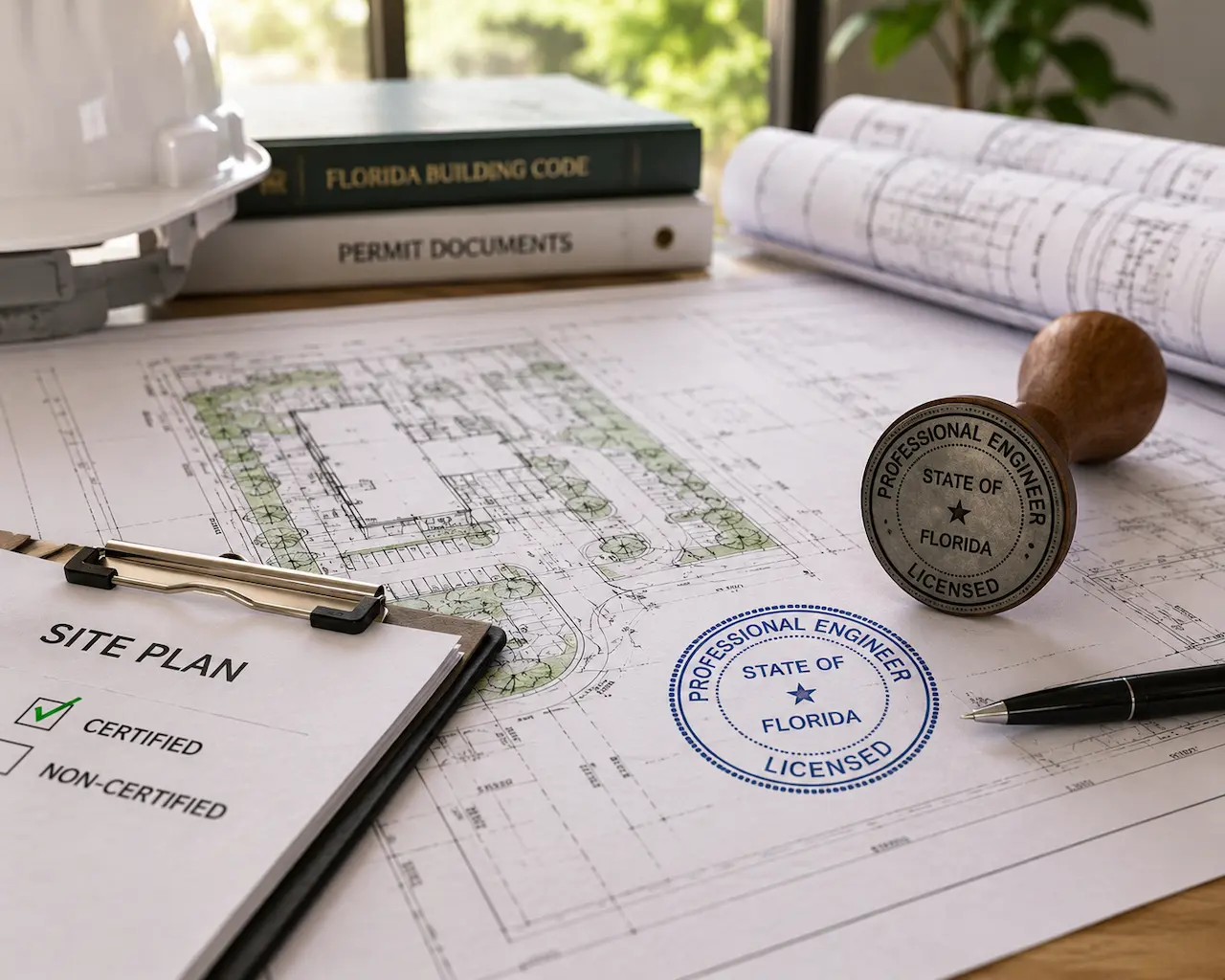
A PE-stamped site plan carries the official seal and signature of a Florida-licensed Professional Engineer. That signature is a legal certification that the plan meets Florida Building Code requirements — including stormwater management, grading, and, in flood-prone areas, elevation compliance.
We prepare these through our PE-stamped site plan service, where a licensed engineer reviews the drawing before sealing it. The stamp matters because it puts professional liability behind the document — which is exactly why some jurisdictions insist on it.
For a full list of project types that typically require a stamp (commercial work, drainage, retaining walls, flood zones, and more), see the PE stamp requirements guide.
Why the Same Type of Project Can Go Either Way
This is where most of the confusion comes from. Two homeowners can both be building a fence, and one needs a stamp while the other doesn’t — because requirements shift based on:
- Your county or city. Miami-Dade, Broward, Hillsborough, and Duval don’t all draw the line in the same place.
- Flood zone designation. A parcel in a FEMA flood zone often needs stamped elevation certification even for projects that wouldn’t normally require one.
- Scope, not just category. A “small addition” and a “500+ sq ft addition” can land in different buckets even though they’re technically the same permit type.
Commercial developments may involve additional engineering and site documentation, making our commercial site plan services relevant for businesses preparing permit applications.
This is also why it’s worth confirming before you order, rather than assuming your project falls into the cheaper or faster category.
How to Find Out Which One Your Project Needs
- Check your county or city building department’s permit checklist for your specific project type.
- Confirm whether your parcel sits in a designated flood zone.
- Ask directly whether structural, drainage, or grading changes are involved.
- Run it through our Florida Permit Requirements Checker for a quick read.
If you’re still unsure whether your project needs a PE-stamped or non-certified site plan, contact our team with your property location and project details. We can help you identify the documentation requirements to confirm with your building department before ordering.
Can You Upgrade Later?
Yes, but it’s more expensive than getting it right the first time. Upgrading a non-certified plan to a PE-stamped one usually means re-drafting portions of the plan for engineer review, on top of the original drafting cost. If there’s any doubt about which category your project falls into, it’s worth checking first rather than upgrading after a rejection.
If your building department requests professional engineering certification, our Florida PE review services can help you explore the review requirements for your existing site plan.
Cost and Turnaround, in Brief
A non-certified site plan is generally faster and lower-cost, since it skips engineer review. A PE-stamped plan takes a bit longer because a licensed engineer has to verify calculations and apply their seal but that’s what makes the document legally defensible if the county questions compliance later.
For exact pricing and turnaround by service tier, see the cost breakdown in our full requirements guide or run your project through the Site Plan Cost Calculator.
Why Choose Site Plans FL
At Site Plans FL, we help Florida homeowners and contractors prepare site plan documentation based on their project needs and local permit requirements.
- Florida-licensed Professional Engineers available for every PE-stamped order
- Plans drafted from current parcel, GIS, and zoning data — not outdated records
- Clear guidance on which option your specific permit actually needs
- Fast turnaround without cutting corners on accuracy
- Direct support if your building department requests revisions
Conclusion
The right site plan depends on what your project involves and where it sits not on which option costs less. Getting this decision wrong is one of the most common reasons Florida permit applications get sent back. When in doubt, confirm with your building department first, or reach out to our team and we’ll tell you exactly which one your project needs.
FAQs
Does every Florida county require a PE stamp on site plans?
No. Requirements vary by county and project type. Most standard residential permits accept a non-certified plan, while new construction and flood-zone properties typically require a stamp.
Can I upgrade a non-certified site plan to a PE-stamped one later?
Yes, but it usually means re-drafting portions of the plan for engineer review, which costs more time and money than ordering the correct version upfront.
Is a PE-stamped site plan the same as a survey?
No. A survey is performed by a licensed surveyor and establishes legal property boundaries. A PE-stamped site plan is engineered for code compliance and doesn’t replace a survey where one is legally required.
What happens if I submit the wrong type of site plan?
Your building department will reject the application and request the correct version, which delays your permit timeline and may require an additional submission fee.
Need a residential, commercial, or PE-stamped site plan in Florida? Site Plans FL provides fast, accurate, permit-ready site plans for property owners and contractors across all 67 counties.