Let me be direct with you: a pool permit in Florida is not optional. And getting the site plan wrong is the single most common reason pool permits get delayed or rejected.
I’ve been preparing pool permit site plans since 2021 across every Florida county from Miami-Dade to Escambia. This guide covers everything you need to know to get your pool permit site plan right the first time.
Why Florida Pool Permits Require a Site Plan
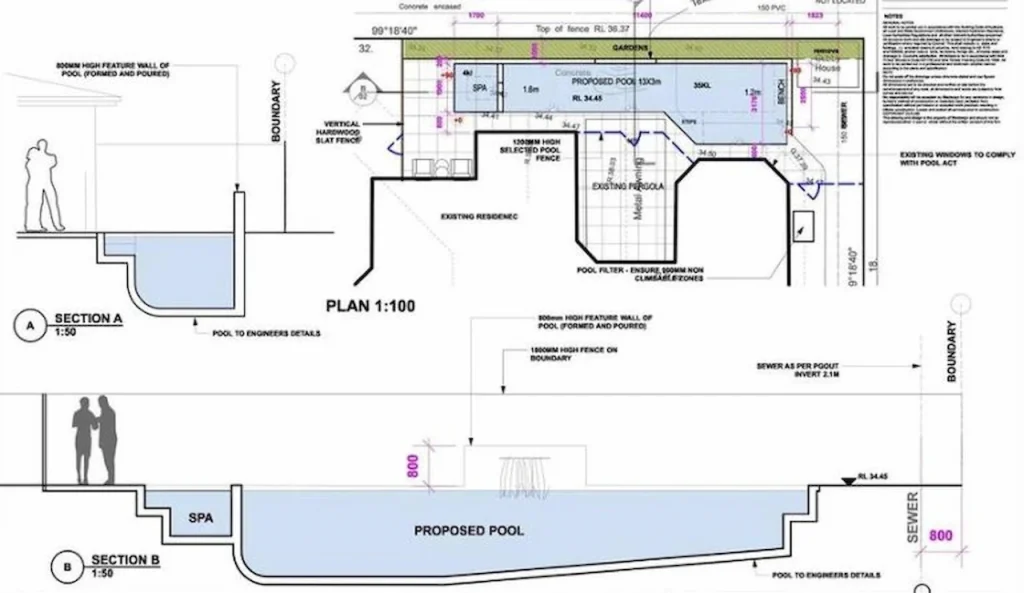
Florida requires a building permit for any in-ground or above-ground swimming pool. The permit process exists because pools affect:
- Structural integrity: excavation near property lines or existing structures
- Drainage: Pools significantly alter surface water drainage patterns
- Safety: Florida law (F.S. 515) mandates safety barriers around residential pools
- Zoning compliance: setback rules protect neighbors and drainage easements
The site plan is how your building department verifies that your proposed pool meets all of these requirements before they let you break ground. Without an approved site plan, no pool contractor can legally start work.
What Florida’s Pool Permit Site Plan Must Show
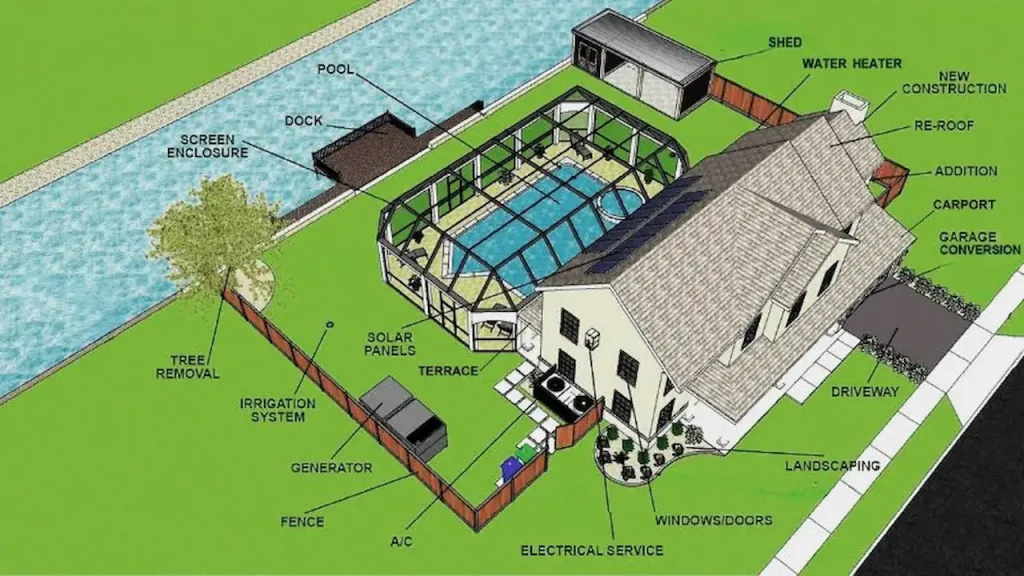
This is the core list. Every Florida county requires at a minimum:
Property basics:
- Lot boundaries with dimensions
- Legal description/parcel ID
- Street address
- North arrow and scale
Pool-specific requirements:
1. Pool location with all setbacks. This is the most scrutinized element. Florida requires:
- Minimum 5 feet from pool water’s edge to rear and side property lines (in most counties, verify yours, as it varies)
- Minimum distance from pool to septic tank and drain field,d if applicable
- Minimum distance from pool to any easement
- Distance from pool to the house (structural footings typically must be at a safe distance; check your county’s rules)
2. Pool dimensions
- Overall pool dimensions (length × width)
- Pool depth (at shallow end and deep end, or for uniform depth)
- Spa dimensions, if applicable
- Equipment pad location and dimensions
3. Pool deck/patio
- Deck dimensions
- Total area of proposed deck
- Contribution to impervious surface calculation
4. Barrier fence compliance:e Florida Statute 515.27 requires a barrier around all residential pools. Your site plan must show:
- Location of the barrier fence
- Gate locations
- Confirmation that the fence meets height requirements (typically 4 feet minimum, with specific gate latch requirements)
- If the house wall serves as part of the barrier, this must be noted with the entry door to the pool area identified
5. Drainage notation
- The direction of water flow away from the pool
- Location of pool backwash drainage, if applicable
- Note on how pool water is to be managed (typically discharged to sanitary sewer or a designated drainage area, not directly to surface)
6. Impervious surface calculation
- Total lot area
- Existing impervious surface (house footprint, existing driveway, existing paving)
- Proposed new impervious surface (pool + deck)
- Total impervious surface as a percentage of lot area
- This must not exceed your county’s maximum (varies by zone, typically 40–60% for residential)
7. Flood zone designation
- FEMA flood zone from the current FIRM map
- If in AE zone: base flood elevation
- In coastal V zones, additional requirements apply
Florida Pool Setback Rules by County
Here’s where it gets important. “Standard” setback rules give you a starting point, but your actual numbers depend on your county, your zoning district, and, in some cases, your specific municipality.
General Florida pool setback guidelines (always verify for your specific address):
Pool water’s edge to property line:
- Most Florida counties: 5 feet rear and side
- Miami-Dade: 5 feet side and rear, 15 feet from the front property line
- Broward: 5 feet from the rear and side, 25 feet from the front
- Palm Beach: varies by municipality. Palm Beach Gardens is different from West Palm Beach
- Orange County: 5-foot side and rear setback from the property line
- Hillsborough: 5 feet from the side and rear property lines
Setbacks from structures:
- Most counties require the pool’s water’s edge to be at least 5 feet from any structure’s foundation
- Some counties require more checks before drawing
Setbacks from septic systems:
- If you’re on a septic system, Florida requires the pool to be a minimum of 10 feet from the septic tank and 15 feet from the drain field (varies by county)
- Hillsborough County Health Department has specific requirements; contact them directly
Setbacks from easements:
- Most drainage and utility easements prohibit any construction, including pools and pool decks, within the easement boundary
- Easements are shown on your property’s recorded plat and survey
Why this matters: I’ve seen projects get to the permitting stage and then fail because the pool was designed 5 feet from the property line, but the county required 7 feet due to a local ordinance overlay, or because there was a drainage easement that nobody checked.
Before you finalize your pool design with a pool contractor, verify your setbacks. We do this for free as part of every site plan order. Use our Permit Drawing Package Finder to get started.
Pool Permit Process in Florida: Step by Step
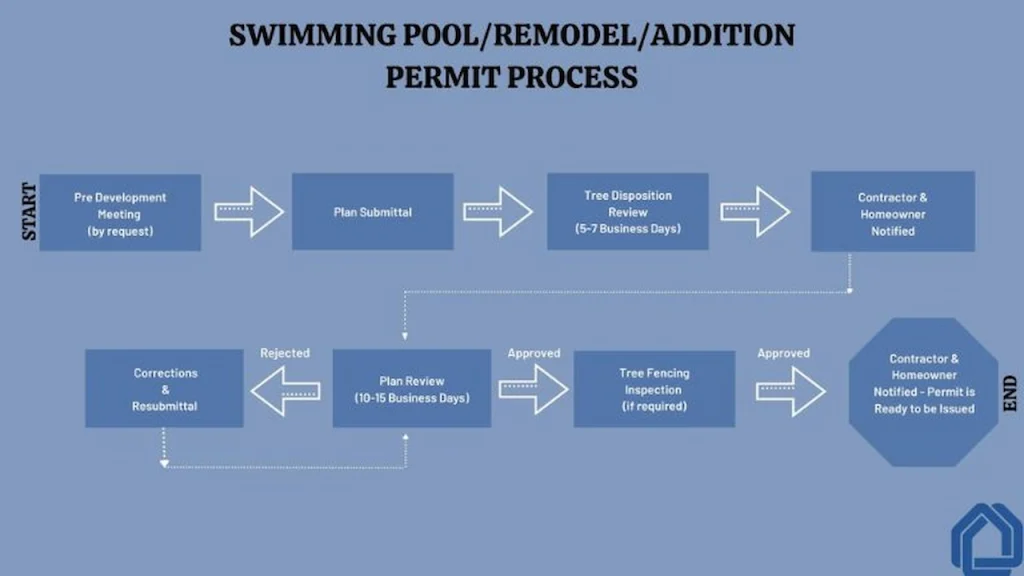
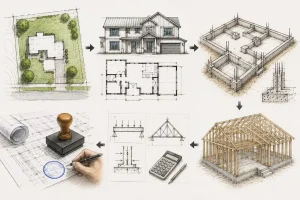
The process varies by county but follows this general structure:
Step 1: The homeowner hires a pool contractor: In Florida, a licensed pool contractor (licensed under F.S. 489) must pull the permit. The homeowner can owner-build, but this is rare and complicated. Most homeowners use a licensed contractor.
Step 2: The site plan is prepared: Either the pool contractor or a third-party service (like us) prepares the site plan. Many pool contractors outsource this because drafting isn’t their specialty.
Step 3: Permit application submitted: The contractor submits the permit application package to the county building department.
This typically includes:
- Site plan (plot plan)
- Pool structural/engineering drawings
- Barrier compliance documentation
- Contractor license information
- Signed owner authorization
Step 4: Plan review: The building department reviews the application. Timeline varies; Miami-Dade can take 2–4 weeks. Smaller counties may be faster. Expedited review is sometimes available for a fee.
Step 5: Permit issued: Once approved, the permit is issued. Construction can begin.
Step 6: Inspections typically include pre-pour (before concrete is poured), electrical, barrier (before water is added), and final inspection.
The Most Common Pool Permit Site Plan Rejection Reasons
Based on what I see coming back from Florida building departments:
1. The barrier fence is not shown or doesn’t comply. This is the most common reason pool permit applications are returned. Florida Statute 515 is specific about barrier requirements. Your site plan must clearly show the barrier location and, where relevant, the house acting as part of the barrier.
2. Setback violations: The pool is placed too close to a property line, septic system, or easement. In most cases, this isn’t a drafting error; it’s a design error. The pool needs to be moved before the permit can be approved.
3. Missing impervious surface calculation: Many building departments require this. If your property is already close to the impervious surface limit, you may need to reduce the pool deck size or use permeable pavers for part of the deck.
4. Wrong flood zone notation: A significant portion of Florida is in FEMA flood zones. If your property is in Zone AE or V, additional information is required, and different rules may apply.
5. No equipment pad shown: Some counties require the pool equipment pad to be shown on the site plan with dimensions and setback from the property line.
If you’ve already been rejected, run your situation through our Permit Rejection Fix Tool to identify the specific issues and get them corrected quickly.
Above-Ground vs. In-Ground Pools: Does the Site Plan Differ?
Yes, slightly. Above-ground pools generally have the same setback requirements as in-ground pools in Florida. However:
- The barrier requirements differ: some counties allow the pool wall itself to serve as the barrier if it meets height requirements (typically 48 inches)
- Above-ground pools often don’t require the same structural engineering drawings
- The site plan still needs to show location, setbacks, and any deck additions
Don’t assume an above-ground pool is a simple permit. In Miami-Dade, even an above-ground pool requires a building permit and site plan. Same in most other Florida counties.
Spa-Only Permits in Florida
If you’re adding a hot tub or spa without a pool:
- Still requires a building permit in most Florida counties
- Site plan required showing location, setbacks, and equipment pad
- Electrical permit required (spas run on 240V circuits)
- Barrier requirements still apply in most cases; a standalone spa is treated as a pool under Florida Statute 515
Pool Additions to Existing Permitted Pools
Adding a spa, expanding an existing pool, or adding a sun shelf to an existing pool:
- New permit required
- Updated site plan required, showing both the existing and proposed conditions.s
- Some counties allow a “revision” permit rather than a new permit. Check with your building department.
Case Study: Hillsborough County Pool Permit
A pool contractor in Tampa contacted us in September 2024. He had a client wanting a 15′ × 30′ pool with a 500 sq ft deck in a standard R-1A zone in Hillsborough County. His previous drafting service was based out of state and unfamiliar with Hillsborough County’s online permit submission system (they use Accela).
Issues with the previous plan:
- Scale was off (drawn at 1″=30′ but submitted without a graphic scale bar)
- A barrier fence is shown, but the Hillsborough-required gate latch notation is missing.
- Pool equipment location not shown
- Impervious surface calculation not included
We redrew the plan from scratch using Hillsborough County GIS data, included all required elements, formatted it for Accela submission, and delivered it in 14 hours.
The permit application was approved on the first review.
The contractor now uses us for all his Hillsborough County pool permit site plans.
Pool Permit Site Plan Cost

A standard Florida pool permit site plan from Site Plans FL: $79
This includes:
- County-specific setback research
- GIS-verified property data
- Pool, deck, and equipment pad shown to scale
- Barrier fence compliance notation
- Impervious surface calculation
- Flood zone designation, if applicable
- Free revisions if the building department requests changes
- 12–24-hour delivery
For PE-stamped site plans (required by some Florida counties for pools over a certain size or in commercial settings): $499
Use our Site Plan Cost Calculator for an instant estimate.
Get Your Pool Permit Site Plan
Tell us:
- Your Florida property address
- Pool dimensions (length × width)
- Approximate deck size
- Whether you have a survey (helpful but not required)
- Your permit deadline
We’ll handle the research, the drafting, and the formatting. You’ll have a permit-ready site plan in your inbox within 24 hours.
Request Your Pool Permit Site Plan $79
We’ve done this for pool contractors and homeowners across all 67 Florida counties. Miami-Dade, Broward, Palm Beach, Orange, Hillsborough, Pinellas, Lee, Collier, we know every building department’s requirements.